What Type of Coolant Does Mercedes Use? Approval Guide
Updated: 2026-11-25
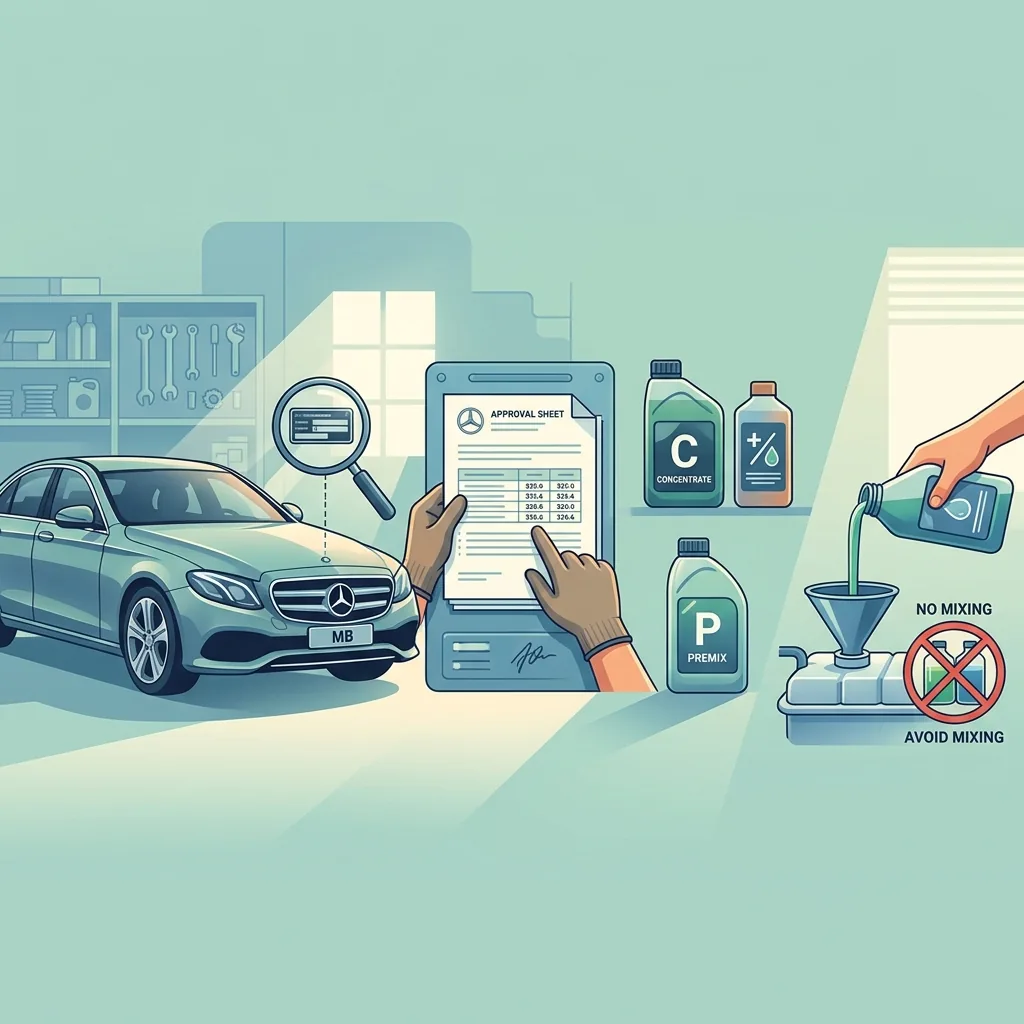
Mercedes-Benz uses coolant approved to a specification for the vehicle’s cooling system. There is no single fluid for every Mercedes. Many engines listed in the current Mercedes-Benz operating fluids guide use the 325.6 concentrate or 326.6 premix family; some older and special applications differ. To choose the right bottle, check your vehicle’s manual, confirm the applicable specification, then find a product on Mercedes-Benz’s approval list.
The useful number is the Mercedes engine coolant specification, often called an MB sheet number. It identifies both the coolant family and whether the product is concentrate or ready to use. In Mercedes-Benz’s Operating Fluids Sheet 310.1, 325.x products are concentrates that must be mixed with suitable water; 326.x products are premixed coolants.
| MB sheet | What the number identifies | Application to check |
|---|---|---|
| 325.0 / 326.0 | Older concentrate / premix family | Vehicles produced through April 2014, subject to vehicle requirements |
| 325.6 / 326.6 | Concentrate / premix family used by many Mercedes vehicles | Confirm the engine or model-series entry |
| 325.7 / 326.7 | A separate concentrate / premix family | Specific applications only; Sheet 310.1 lists no compatible coolant sheet for this family |
| 326.64 | A special premix | Only the M178 engine in model 190.381 is listed, with a 40% concentrate requirement |
This table explains the labels; it is not a coolant-by-model-and-year fitment chart. Operating Fluids Sheet 320.1 lists applications by engine family and includes restrictions. For example, its permission to use the 0 family on certain engines applies only to vehicles produced through April 2014. A model year alone may not tell you the production date or account for a particular engine.
Coolant does more than prevent freezing. Its inhibitors protect cooling-system materials from corrosion, while the specified mixture supports heat transfer and boiling protection. Mercedes-Benz warns that a product absent from its approval sheets does not have MB approval. A bottle’s color or a retailer’s generic “fits Mercedes” claim cannot replace the specification check.
Use these four steps before ordering coolant, especially if the car is used or its service history is incomplete.
Open the manual for your exact vehicle. Start with the Mercedes-Benz USA owner’s manual library or the manual supplied with the car. Match the model, model year and variant. Look under “Coolant,” “Operating fluids” or “Technical data.” Older manuals may name the MB sheet directly: the 2012 S-Class manual, for instance, specifies MB 325.0 or 326.0. Other manuals direct you to Sheet 320.1.
Check the applicable entry in Sheet 320.1. Find the engine family or the relevant model-series entry, then read its notes and restrictions. The sheet distinguishes approved, restricted and prohibited applications. If you cannot identify the engine confidently, ask a Mercedes-Benz service or parts department to confirm the specification using the VIN. Do not select a sheet from the badge on the trunk alone.
Read Sheet 310.1 for preparation and compatibility. This sheet explains the difference between concentrate and premix, the required concentration, water quality and mixing limits. A permitted fluid for one vehicle may be unsuitable in another. It also notes special applications that need different treatment.
Match a listed product to that sheet. Open the corresponding coolant product page on the Mercedes-Benz Operating Fluids site. Check the exact product name and specification against the container you will buy. Lists can change, so use the current page when purchasing.
The order matters: a product can appear on an official approval list yet belong to the wrong sheet for your car. Determine the vehicle’s required sheet first, then choose a product approved under it.
Look for a specific statement such as “MB-Approval 325.6” or “MB-Freigabe 325.6.” Mercedes-Benz describes these terms in Sheet 310.1. Check the final digits carefully: 325.6 concentrate and 325.7 concentrate have different applications. “Suitable for,” “recommended for” and a matching color do not establish that Mercedes-Benz approved the product.
The official 325.6 product list and 326.6 product list also show why brand name alone is insufficient: products from several manufacturers appear under each sheet. What matters is the exact approved product and whether that sheet applies to your vehicle.
Sheet 310.1 describes typical colors for several coolant families, but different sheets can have overlapping colors. The fluid already in a reservoir may also have been changed during an earlier service. If a bottle is pink and the reservoir fluid is pink, that still does not prove they can be mixed.
Compatibility has direction and application limits. Sheet 310.1 describes backward compatibility for certain 6-family products in older 0-family applications, while 0-family products are not allowed in vehicles produced after April 2014. The sheet lists no compatible coolant sheet for the 7 family. Check the current sheet and the car’s service history before combining fluids; if either is uncertain, do not mix them.
If your vehicle calls for a 325.x concentrate, mix it with water before it enters the cooling system. Sheet 310.1 gives a 50% concentrate and 50% water target for standard 325.0, 325.6 and 325.7 preparations, with stated exceptions. It also sets water-quality requirements. Where the quality of available water is unknown, Mercedes-Benz says distilled or deionized water can be used.
A 326.x product is already mixed. Do not routinely dilute it: extra water changes the antifreeze and corrosion-inhibitor concentration. Follow the bottle and vehicle instructions, since special premixes have different ratios. Several recent Mercedes-Benz manuals specifically instruct owners to use coolant premixed to the required protection level.
First read the exact manual’s coolant-level procedure. Some models describe an owner check and refill; the 2024 E-Class manual says to use premixed coolant with the required antifreeze protection, only use Mercedes-Benz-approved coolant, and have coolant regularly replaced at a qualified specialist workshop. It points owners to Operating Fluids Sheet 320.1 for coolant information.
Where the manual permits an owner top-up, park on level ground and let the engine cool. A warm cooling system is pressurized: opening its cap can release scalding coolant. Follow the manual’s instructions for the reservoir, level mark and cap. Add only the approved prepared coolant, and avoid filling above the specified mark.
A low level is also a reason to look for a leak. Mercedes-Benz’s guidance calls for the system to be checked when coolant is low. If the level falls again, a warning returns, or you see fluid beneath the vehicle, arrange an inspection rather than repeatedly topping up. If the display says the coolant is too hot and instructs you to stop, follow that warning immediately; do not open the cap while the system is hot.
A used car may contain fluid from a previous repair, and its color will not reliably identify the MB sheet. Check invoices or service records for the product and specification used. If the records do not settle it, give a qualified shop the VIN, the required sheet and the uncertainty about the existing fill. The shop can determine how to restore the correct coolant without an unsupported mix.
Be especially careful after cooling-system work. A replacement part or past service measure does not automatically authorize a different coolant. Sheet 320.1 includes a note about vehicles converted during a service measure and the procedure required at a later change. That is a case for vehicle-specific service information, not a guess based on a general chart.
For a straightforward purchase, keep a short record: your vehicle and engine, the required MB sheet, the approved product name, and whether you bought concentrate or premix. It makes the next top-up easier and gives the next technician something useful to verify.
No. Mercedes-Benz lists several coolant families and applications. Sheet 310.1 describes typical colors, but color does not establish approval or compatibility. Find the required MB sheet from the vehicle manual and Sheet 320.1, then match a listed product to it.
They belong to the corresponding 6 family, but 325.6 identifies a concentrate and 326.6 identifies premixed coolant. The concentrate needs preparation with suitable water to the specified ratio. The premix is ready to use as directed. Confirm that the 6 family is approved for your vehicle before buying either.
Do not decide from color. Mercedes-Benz’s compatibility rules depend on the sheet numbers and vehicle application. Some 6-family products have limited backward compatibility with the older 0 family; the reverse does not apply to later vehicles. If you cannot identify what is already in the system, have the fill checked before adding another product.
There is no useful interval for every model in a general coolant guide. Follow your vehicle’s maintenance information and any applicable service instructions. Mercedes-Benz also calls for the coolant level and condition to be checked during service. An unexplained drop in level needs attention regardless of the scheduled change date.