Mercedes Leaking Engine Coolant: Signs and Safe Next Steps
Updated: 2026-11-25
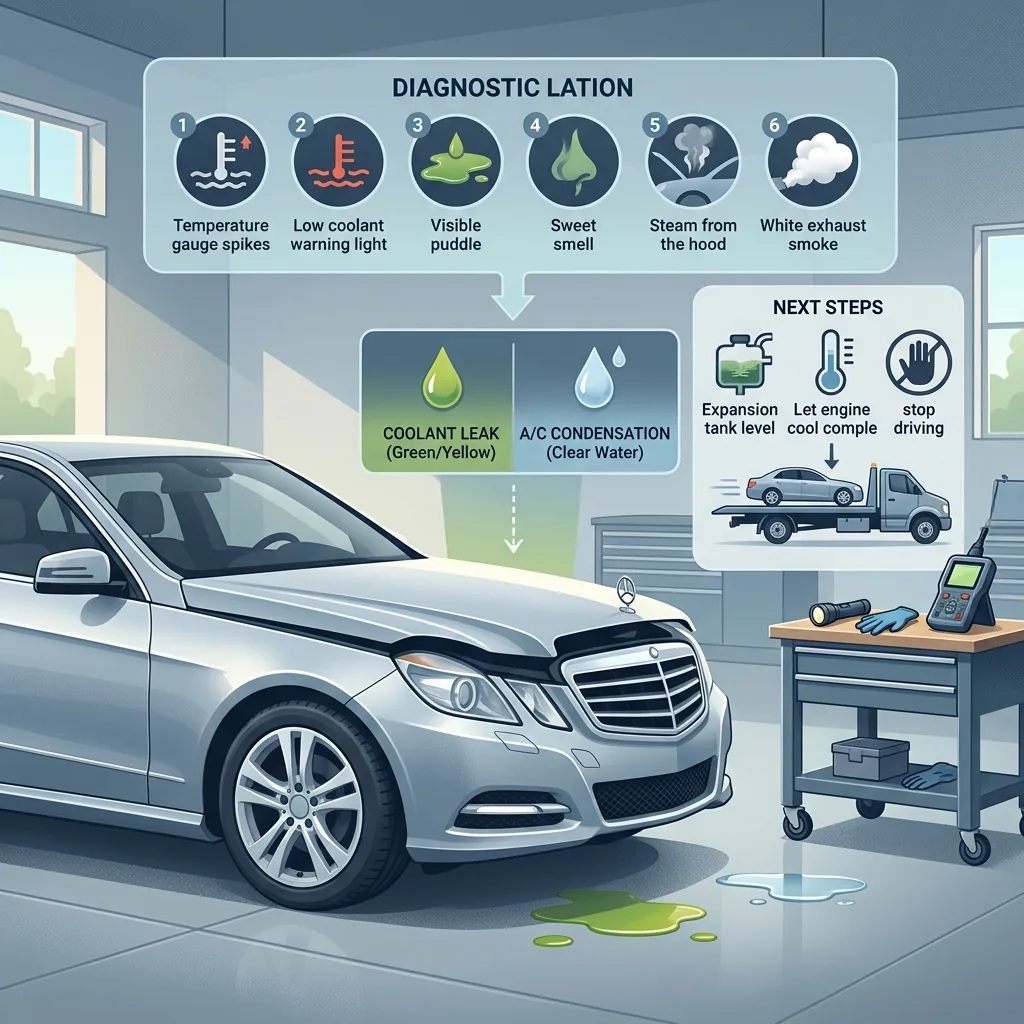
A Mercedes leaking engine coolant needs attention even if the engine still feels normal. Look for a repeated low-level warning, a falling reservoir level, a fresh wet trail beneath the vehicle, or rising temperature. If the display says to stop, the engine overheats, or coolant is visibly escaping, pull over safely, switch the engine off, and arrange roadside assistance.
A leak may be obvious or hidden beneath an engine cover. Symptoms help establish urgency, not the failed part.
| What you notice | What it may mean | Immediate response |
|---|---|---|
| A recurring coolant-level message | The level is low; the cause still needs checking | Check the exact message and the level after the engine cools |
| A fresh wet trail or puddle beneath the vehicle | The fluid source cannot be confirmed by location or appearance alone | Photograph it from outside; if coolant is visibly flowing or a warning returns, stop safely and seek assistance |
| Dried residue around cooling-system parts | The residue is a clue to document, but it does not identify the failed part | Arrange an inspection |
| Rising temperature, steam, or an instruction to stop | The engine may no longer be cooling adequately | Stop safely, switch off the engine, and seek roadside help |
The wording on the display matters. In a Mercedes-Benz owner's manual, “Check Coolant Level” calls for checking and adding coolant according to the manual, then inspecting the system. “Coolant Too Hot Stop Vehicle Turn Engine Off” calls for stopping and switching the vehicle off. Other model years use different wording, so read the message on your car rather than assuming every coolant alert means the same thing.
A falling cold level is another clue. Compare readings with the car parked level and the engine cool. If the warning returns after a top-up, do not treat it as a routine refill: the Mercedes-Benz manual directs owners to have the cooling system checked when coolant is low.
If you see liquid under a parked Mercedes, look from outside the vehicle; do not crawl under a car supported only by a jack or reach into a hot engine bay. Mercedes-Benz warns that engine-compartment components may continue running or start unexpectedly after the vehicle is switched off. See the owner’s manual safety notes.
Clear, odorless water after using the air conditioner is often condensate; AAA explains this common A/C drip in its vehicle safety guide. Mercedes-Benz’s Operating Fluids Sheet 310.1 lists different colors for coolant families, so color alone cannot confirm the leak source or the vehicle’s required specification. A puddle’s location is only a clue; ask a shop to identify the fluid if you are unsure.
Check the cold reservoir level and whether the spot gets wet again. Photograph the puddle and warning. If unsure, have a shop identify the fluid. Keep children and animals away from spilled coolant, and clean up a spill only when it is safe to do so.
Cooling systems use model-dependent components and connections. Common areas a qualified shop may inspect include hoses, radiator, water pump, thermostat, and related fittings; AAA lists these among common cooling-system problems in its repair guide. The exact layout and component names vary by vehicle.
The cooling system is pressurized while warm. Do not open it to look for a leak; the Mercedes-Benz coolant procedure warns that hot coolant can spray out. The absence of a visible puddle does not establish why the level is falling, so have the system inspected.
If coolant continues to disappear without an obvious puddle, the cause cannot be identified from the reservoir alone. Mercedes-Benz’s Operating Fluids Sheet 310.1 says a low level requires the engine cooling system to be checked for condition and fluid loss. Ask a qualified shop to inspect it rather than guessing at a failed part.
Some vehicles have separate cooling circuits. The 2024 C-Class manual, for example, lists distinct engine and high-voltage-battery cooling circuits. Use the manual for your own model and year; do not assume every reservoir serves the engine circuit.
If steam appears, the temperature rises toward its warning zone, a stop-engine message appears, or coolant is pouring out, move to a safe place as soon as traffic allows. Switch the engine off. Keep clear of steam and hot fluid; if the engine has overheated, let it cool before opening the hood. Do not restart it just to see whether the warning has cleared. Arrange roadside assistance or a tow. Mercedes-Benz warns that an overheated engine and escaping fluids can cause burns and engine damage.
If there is a fire in the engine compartment, keep the hood closed and call the fire service, as the Mercedes-Benz manual instructs.
For a suspected leak, park on level ground and wait until the engine and cooling system have cooled. Follow the manual for your model to read the level and determine whether a cap needs to be opened. Never loosen a hot coolant cap. The system is pressurized, and hot coolant can spray out. If the manual calls for opening a cooled cap, follow its instructions for gloves, eye protection, and slow pressure release.
If the level is low, use only coolant approved for the specific vehicle, in the form and method its manual specifies. Mercedes-Benz's coolant-check procedure calls for approved coolant; it does not give a universal choice based on color. Do not pour in a random antifreeze or a stop-leak product to get home. Adding fluid does not repair the opening that let it escape.
Do not decide whether to drive based only on the distance to a shop. Follow the exact message and the manual for your model. If the display says to stop, the engine overheats, coolant is visibly escaping, or the level cannot be checked safely, do not continue driving; contact roadside assistance or arrange a tow. For a low-level message without overheating, consult the manual and call a qualified workshop for model-specific direction.
Describe what happened before asking for a part: when the warning appeared, whether the engine was hot, where the puddle formed, whether the heater worked, and whether coolant was recently added. Photos of the message, the cold reservoir level, and the parking spot help if the leak has dried by appointment time.
Ask the technician to locate the source, check the system under appropriate test conditions, and inspect nearby hoses, reservoir, cap, radiator, pump, and related connections as applicable. If no external leak appears, ask what checks will rule out an internal loss. The inspection method should fit the vehicle and the symptoms; ask the shop to explain what it checked and what the result showed.
Before approving repairs, ask for the failed component and test result. Confirm the coolant specification and model-specific filling procedure. After repair, ask the shop to verify that the level remains stable and no leak reappears. A new low-level warning after the repair needs a follow-up, even if the engine temperature looks normal.
Do not drive if the engine is overheating, steam is visible, coolant is escaping rapidly, or the display tells you to stop. A low-level warning or suspected leak does not establish that driving is safe. Follow the model’s manual and contact roadside assistance or a qualified workshop for guidance; when in doubt, arrange a tow.
A small leak may dry on a hot component or collect on an undertray. The car may also have a leak that only appears under pressure or an internal problem. Repeated Mercedes coolant loss needs a cooling-system inspection; the lack of a puddle does not clear the system.
Clear, odorless water after air-conditioning use is commonly condensate. Compare it with the cold reservoir level and watch for a recurring coolant warning. If the fluid is not clearly water, or the reservoir level is falling, have it identified by a qualified shop. Do not identify a fluid by color alone.
No. Top up only as the owner's manual directs, with coolant approved for your vehicle, and arrange diagnosis if the level falls again. Repeated refilling can hide a worsening leak. If the system cannot hold coolant or the engine gets hot, stop driving and arrange a tow.