Mercedes Check Engine Light Flashing and Car Shaking
Updated: 2026-11-28
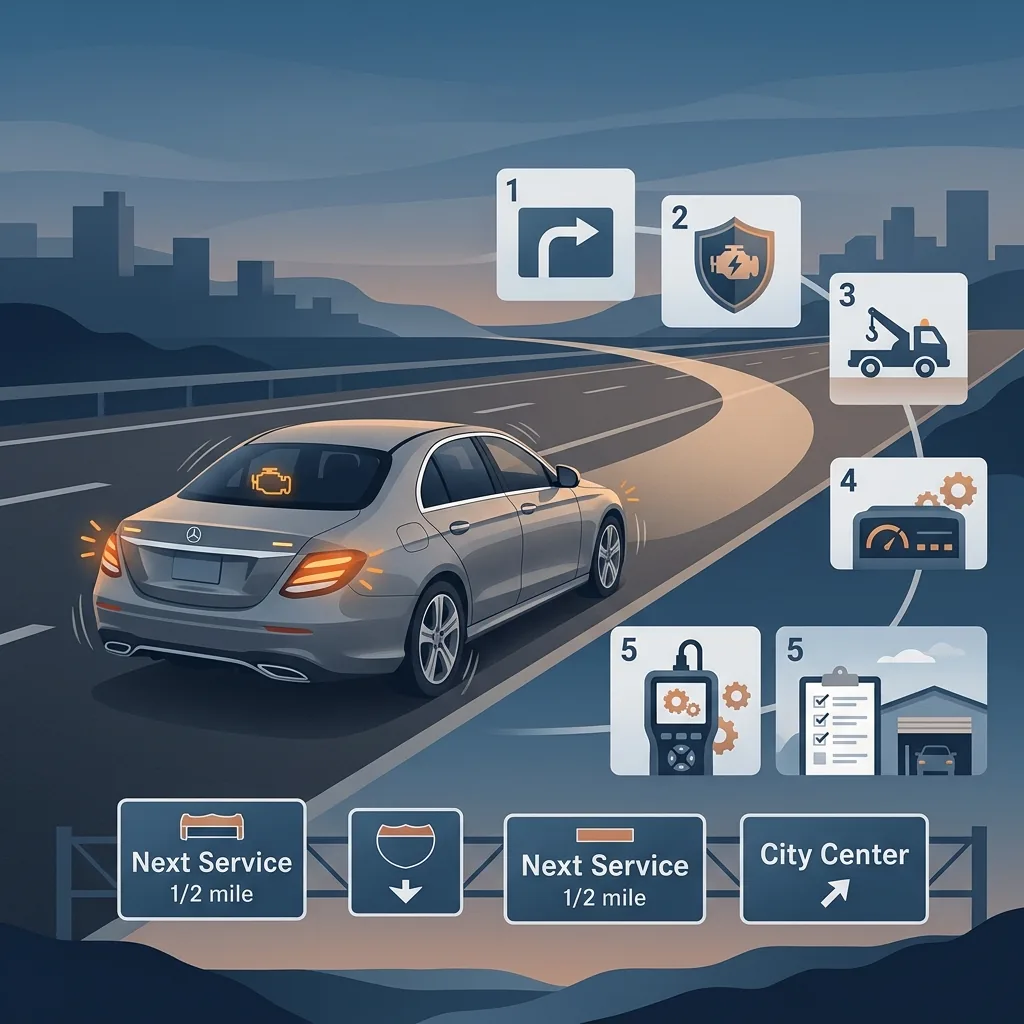
If your Mercedes check engine light is flashing and the car is shaking, ease off the accelerator, signal, and pull over as soon as you can do so safely. Switch off the engine once parked. Treat the combination as an active fault that needs prompt diagnosis; if the shaking continues or the light flashes again, arrange a tow.
Keep your attention on traffic. Avoid hard acceleration and do not try to maintain highway speed against a noticeable loss of power. Turn on the hazard lights when they help other drivers see that you are slowing. Signal and move toward a parking lot, exit, or wide shoulder. Do not brake suddenly or stop in a live lane just to protect the engine. Getting yourself and your passengers out of traffic comes first.
If the car barely responds to the accelerator, stalls, or shows another urgent warning, use the safest reachable stopping point. Note the nearest exit, cross street, or mile marker so help can find you.
Select Park, apply the parking brake, and shut off the engine. Do not let it idle while you search for a cause: an active misfire can continue while the car is stationary. If you see smoke, smell fuel, or suspect a fire, move people away from the car when it is safe to do so and call emergency services. Do not open a hot or smoking engine compartment.
On a highway shoulder, remain buckled in the car if it is well clear of traffic and safe to stay there. If the car is exposed to traffic or smoke, leave from the side away from moving vehicles when safe and wait well clear of the roadway. AAA’s breakdown guidance explains how the safest waiting place depends on the position of the car.
A flashing engine light on a Mercedes is more urgent than a light that stays on steadily. The U.S. Environmental Protection Agency explains that a blinking malfunction indicator lamp can signal a severe engine misfire; continued operation can damage emissions equipment, particularly the catalytic converter. Mercedes-Benz USA also advises pulling over when the Check Engine light flashes.
Shaking makes an active misfire plausible: one or more cylinders may not be contributing smoothly, so the engine runs unevenly. You might notice a rough idle, weak acceleration, or a pulsing exhaust note. These clues describe how the car behaves. They do not identify the failed component.
An ignition coil or spark plug could be involved, but fuel delivery, an injector, an intake air problem, wiring, or a mechanical fault can produce similar symptoms. The Mercedes-Benz owner’s manual describes a steady Check Engine warning as a possible engine, exhaust, or fuel system malfunction. The exact warning messages and procedures vary by model and year, so check your own manual once you are safe.
A steady light is not proof that the problem is minor. Likewise, if flashing stops when you release the accelerator, the underlying fault may still be present under load. The change in the lamp is useful information for a technician, not clearance to finish a long trip.
The safe choice depends on how the car behaves now, the road around you, and any other warnings. Use this as a decision guide after you have stopped:
| What you observe | Next step |
|---|---|
| Light still flashing, engine shaking, or clear loss of power | Switch the engine off and arrange transport to a repair shop. |
| Smoke, fuel smell, rising temperature, oil pressure warning, or repeated stalling | Keep the engine off. Move to safety and request urgent help; call emergency services if there is immediate danger. |
| Flashing has stopped, but the engine still runs roughly | Do not treat the steady or unlit lamp as a fix. Arrange a tow. |
| Flashing and shaking were brief, and the engine now seems smooth | Contact a qualified shop or roadside provider before driving. Describe what happened and follow the advice for your exact vehicle. |
There is no universal safe distance you can drive with a flashing Check Engine light. Driving a short distance only to leave a dangerous position is different from continuing to a shop several miles away. If you cannot tell whether the engine is still misfiring, choose transport.
Tell the dispatcher your model and year, location, symptoms, and whether the car will start and shift into Neutral. Ask the provider to check the towing instructions for your specific Mercedes. Towing methods differ by drivetrain and powertrain. Tell the provider your exact model, year, and powertrain, and have them follow the towing instructions in that vehicle’s owner’s manual.
You do not need to diagnose the engine on the roadside. Record what you can see or remember without opening the hood or standing near traffic:
A loose fuel cap can turn on a Check Engine light, but it does not explain marked shaking. Do not let a quick cap check delay help or persuade you to drive a rough-running car. Avoid pulling ignition connectors, touching hot parts, or repeatedly restarting the engine to see whether the light returns.
If you already have a scan tool and the car is parked safely, reading stored and pending fault codes may help the shop. Save the exact codes and any freeze-frame data if the tool shows it. Do not clear codes, disconnect the battery, or reset the lamp before diagnosis. That removes clues without repairing the fault.
Give the technician your timeline and any photos or codes. A useful work order starts with the symptom: “Check Engine light flashed; car shook under acceleration; engine was switched off after stopping.” Include whether the light later became steady and whether any fuel smell, overheating, or stalling occurred.
The shop can scan all relevant systems, look at stored and pending codes and operating conditions, and identify which cylinders or systems need testing. A misfire code points toward an area to investigate; it does not prove that a coil, plug, or injector must be replaced. The technician may inspect ignition parts and wiring, test fuel delivery or injection, check for unwanted air, and assess mechanical condition if the first checks do not explain the fault.
Ask what test supports the proposed repair. For example, if a coil is blamed, the shop should be able to explain how it confirmed that the fault follows that coil or how electrical testing identified a failure. If the engine ran badly for a while, ask whether the catalytic converter needs evaluation after the misfire is fixed. Replacing a converter while leaving the cause of the misfire unresolved risks another failure.
Get an estimate that separates diagnosis, parts, and labor. The first scan is a starting point, not a complete diagnosis. You can approve the next test or repair with a clearer idea of what it is meant to prove.
Before taking the car back, ask what caused the flashing warning, which tests confirmed it, and what was repaired. The technician should verify that the engine idles and accelerates smoothly and that the warning does not return under appropriate test conditions. A cleared lamp alone is not proof of a successful repair.
Keep the invoice and the original fault codes. If the shake or warning returns, stop safely again and give the shop the new circumstances: speed, engine load, weather, and whether the car was cold or fully warmed up. An intermittent fault may require more targeted testing even when the car seems normal at pickup.
Do not use distance alone to make the decision. If the light is flashing, the car is shaking, power is weak, or the symptoms return after a restart, stop and arrange transport. A short move to reach a safe place is different from driving to an appointment.
The change does not show that the fault is repaired. The misfire may occur only at a certain speed or load, and the car may still hold diagnostic information. Avoid testing it by repeated acceleration. If it shakes again, switch it off and request a tow.
A gas cap may explain some Check Engine warnings; an engine mount can cause vibration. Neither is a good explanation to rely on for a flashing lamp with pronounced shaking. Have the engine fault diagnosed before deciding that either simple fix applies.
No. A code identifies the system or cylinder where the computer detected a problem. Several faults can lead to the same code. Save the code and the conditions in which it appeared, then have the suspect components tested before buying parts.