Mercedes Service History by VIN: What to Check
Updated: 2026-11-19
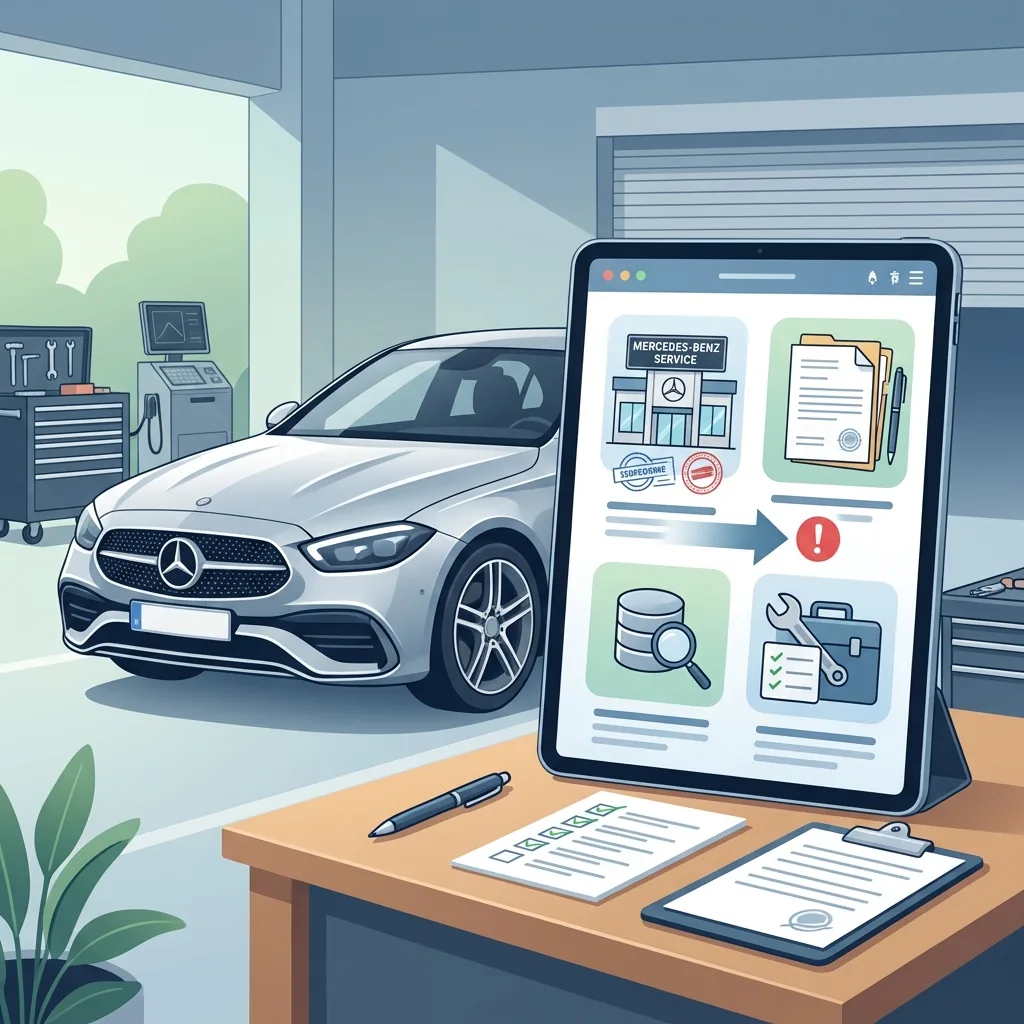
To check Mercedes service history by VIN before buying, first confirm that the VIN on the car matches the listing and paperwork. Then request dealer service reports and repair invoices from the seller, compare them with a vehicle history report, and arrange an independent inspection. A VIN identifies the car; it does not unlock a guaranteed, complete maintenance history.
Start this process before paying a deposit. It gives the seller time to find missing invoices and gives you time to check claims such as “fully serviced” against work that can be documented.
The vehicle identification number is the link between the car and every record you collect. Get it from the seller before you travel. For a typical U.S. passenger car, look through the windshield at the driver’s side of the dashboard, then compare that number with the vehicle’s registration or title and the seller’s documents. NHTSA explains where to find the VIN.
Check every character, not just the last few digits. A mistyped VIN can return records for no vehicle at all. A VIN that differs between the car and its paperwork needs an explanation before you continue.
Ask the seller to send a clear photo of the VIN on the car and photos of the service records. They can cover their name, address, and payment details, but the VIN, service date, odometer reading, shop name, and work performed need to remain visible. A stack of invoices for a different Mercedes-Benz is no evidence for the one you are buying.
If a report identifies a different model or model year than the car in front of you, pause and resolve the discrepancy. Do not build a purchase decision around a report until you know it belongs to that vehicle.
Ask the seller for two things: any Mercedes-Benz digital service reports available for the car and the original invoices or repair orders from the shops that worked on it. A service summary may confirm that a visit took place. An itemized invoice tells you what the technician inspected, replaced, recommended, or left unresolved.
Ask the seller for any service records it can obtain from Mercedes-Benz dealers, along with original invoices or repair orders from independent shops. Request the documents before you commit so you can compare dates, mileage, and work performed. The official Mercedes-Benz USA manuals page helps identify the right service and warranty material by model year; a manual explains scheduled maintenance but does not prove which work a particular car received.
Use a specific request: “Please send the digital service reports and itemized repair orders you have for this VIN, including the most recent visit.” If the seller says a dealer has the records, ask them to obtain copies before you commit. A verbal statement that “the dealer has everything” is difficult to check.
Also ask about work done outside the Mercedes-Benz dealer network. Independent shops may have maintained the car well without those visits appearing in the records a dealer supplies. Receipts for parts bought by an owner are useful context, but a parts receipt alone does not show that a repair was completed correctly.
Treat a dashboard service reminder as a reminder, not a historical record. A reset display cannot tell you which fluids, filters, or other parts were actually changed.
Mercedes online service history is not the same thing as a public website that reveals every repair when you enter a VIN. If the seller has records in a Mercedes-Benz account, ask them to show or export what is available for this vehicle. Do not assume that an app screen contains all past work.
Use other VIN-based sources for different questions:
| Source | Useful for | Main limit |
|---|---|---|
| Seller’s invoices and service reports | Confirming dated, vehicle-specific work | May be incomplete or missing earlier owners’ records |
| Commercial vehicle history report | Finding reported ownership, mileage, damage, and some service events | Shows only information supplied to the provider |
| NMVTIS-approved history provider | Checking reported title, salvage, and insurance-loss information | Does not provide a routine maintenance log |
| NHTSA VIN recall search | Finding certain unrepaired safety recalls | Does not show completed recalls or ordinary service |
The FTC recommends a vehicle history report, but says it is not a substitute for an independent inspection. A commercial report can add useful dates and mileage readings to your timeline; it cannot prove that every oil change or repair was recorded. CARFAX cautions that accident and damage details may be missing from its report.
Use the NHTSA recall search as a separate safety check. A result showing no unrepaired recalls does not establish that the car was serviced on schedule.
Put the used Mercedes maintenance records in date order. For each entry, write down the odometer reading, shop, work completed, and any recommended work. Keep recommendations separate from completed repairs: “brake fluid exchange advised” is not proof that the fluid was exchanged later.
Find the service and warranty material for the car’s exact model and year through Mercedes-Benz USA’s manuals page. Check the applicable maintenance items against the invoices. Service A or Service B on a receipt is a starting point, but the label alone does not establish that every additional item due for that vehicle was performed.
Look for evidence of recurring maintenance as well as less frequent work specified for that model. Depending on the vehicle, its age, and its equipment, that may include filters, brake fluid, spark plugs, or drivetrain fluids. Do not apply a schedule from a different engine or model year. For an electric Mercedes-Benz, use its own maintenance guidance rather than a gasoline model’s checklist.
Read across the entire timeline. Does mileage generally rise as dates advance? Do later invoices address problems noted earlier? Is the most recent service supported by a dated document, or only by the seller’s statement?
An odd mileage entry may be a clerical mistake, a units mix-up, or a more serious problem. Ask the issuing shop to clarify it when possible. Likewise, a long stretch without records does not automatically mean no maintenance occurred, but it leaves you unable to verify that work.
Pay particular attention to repeated complaints with no documented resolution. Several visits for the same warning message or leak warrant a closer inspection, even if the seller says the car now drives normally. A final invoice should show what was diagnosed and repaired, not merely that the car visited a shop.
Missing paperwork is common in a car that has changed owners. Your job is to separate an explainable gap from a claim the seller cannot support.
Ask for the shop’s contact details when an invoice is missing. With the seller’s help, the shop may be able to reissue a record. If it cannot, mark that work as unverified. Do not fill the gap with an assumption based on how clean the car looks or how confidently the seller describes it.
Give extra attention to these patterns:
A record of regular visits is encouraging, but it does not certify the car’s current condition. Tires, brakes, leaks, electronics, and accident repairs still need to be assessed on the vehicle itself.
Give an independent Mercedes-Benz specialist the VIN, the records you collected, and a short list of unresolved questions. Ask for a written pre-purchase inspection that identifies current faults, likely near-term work, and any areas the shop could not evaluate. The FTC advises an independent inspection even when a dealer has inspected or certified a used vehicle.
Use the results to make a decision. Complete, consistent records and a satisfactory inspection support the seller’s asking price. Documented maintenance gaps or necessary repairs give you specific items to discuss in the offer. An unexplained VIN discrepancy, refusal to provide available records, or refusal to permit an inspection may be reason to walk away.
Before signing, keep copies of the reports and invoices you relied on. Record any promised repair or inspection condition in writing. You should be buying the condition you can verify, rather than a service history you have only been told exists.